
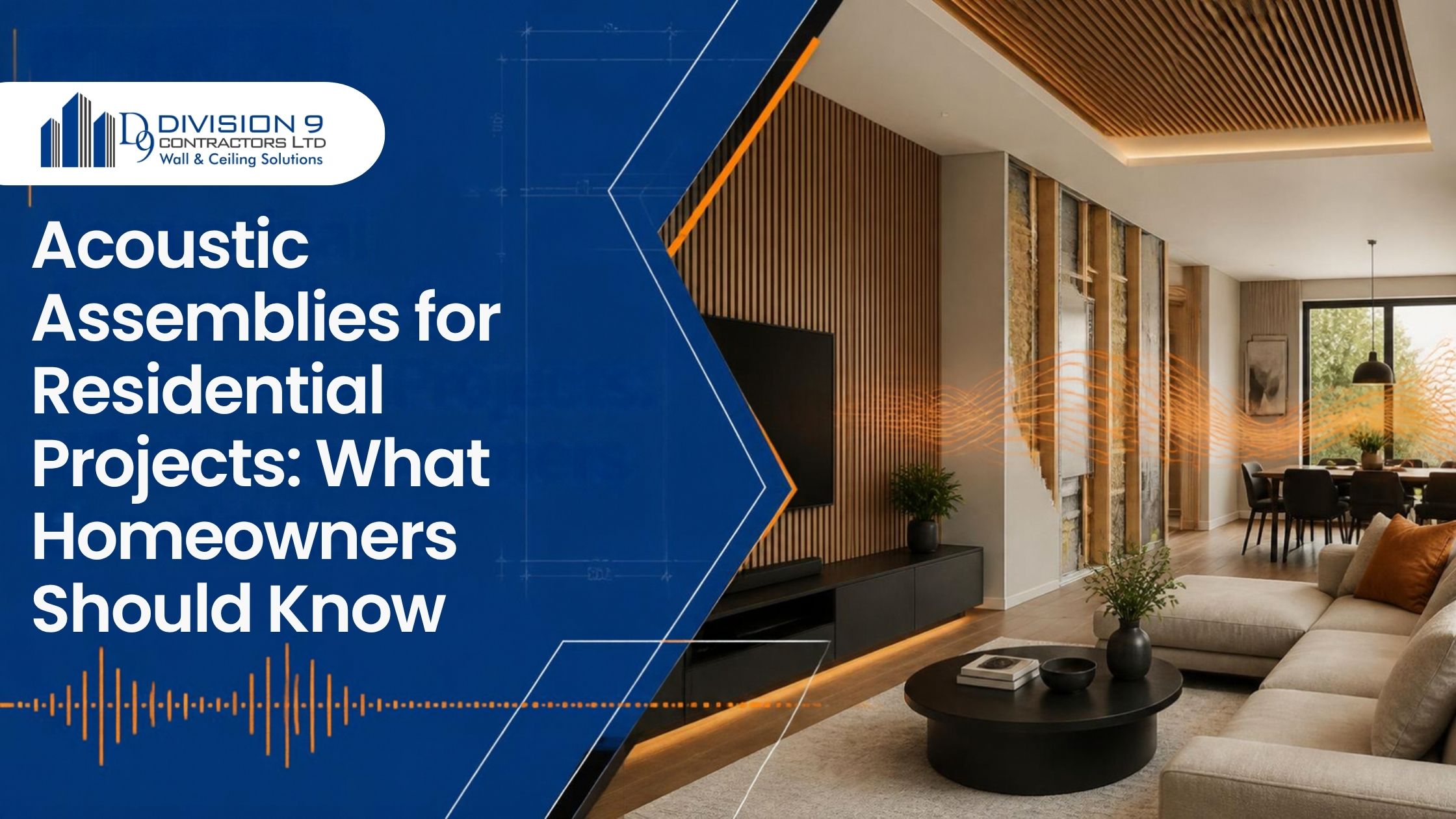
Creating a quiet, peaceful indoor environment is one of the most impactful investments homeowners, custom builders, and residential developers can make. With the rise of remote work, home theaters, multi-family secondary suites, and higher-density urban housing throughout British Columbia, controlling sound transmission within residential spaces has shifted from a luxury feature to a core structural requirement.
Whether building a new custom home, finishing a basement suite, or renovating a multi-story residence, understanding how acoustical assemblies work enables homeowners to make informed decisions about soundproofing wall and ceiling structures.
Understanding Household Noise: Airborne vs. Impact Sound
To effectively quiet a residential space, it is essential to distinguish between the two primary types of sound that travel through home interiors:
- Airborne Sound: Speech, television audio, music, and pet activity travel through air paths and pass through lightweight wall and floor structures. Airborne noise is controlled using dense mass, absorptive insulation, and airtight perimeter seals.
- Impact Sound: Footsteps, dropped objects, slammed doors, and mechanical vibrations travel directly through rigid structural framing (joists and studs). Impact sound control requires mechanical decoupling to interrupt the transfer of physical vibrations.
In British Columbia multi-family construction and legal secondary suites, the BC Building Code (BCBC) establishes clear mandatory acoustic limits, requiring an Apparent Sound Transmission Class (ASTC) rating of at least 47 for residential separation assemblies.
High-Performance Soundproofing Areas in the Home
Targeting specific rooms during construction or renovation yields the highest return on investment for indoor acoustic comfort:
1. Secondary Suites and Rental Apartments
Legal basement suites and multi-family floor assemblies represent the single most critical area for acoustic control. Installing high-density mineral wool insulation within floor joist cavities combined with resilient channels and double-layer 5/8-inch Type X drywall on the ceiling drastically reduces both footstep noise from above and conversational noise from below.
2. Home Offices and Study Spaces
Remote workers require private spaces free from household background noise. Framing home office walls with light gauge steel studs or sound-isolated wood framing, packing stud bays with acoustic batt insulation, and sealing wall perimeters with non-hardening acoustical sealant ensures complete speech confidentiality during remote meetings.
3. Home Theaters and Media Rooms
Media rooms generate powerful low-frequency bass sounds that easily penetrate standard residential drywalled partitions. Controlling low-frequency energy requires adding physical mass (multiple layers of drywall), viscoelastic damping compounds sandwiched between gypsum boards, and decoupled framing walls to keep sound contained within the room.
4. Bedrooms and Primary Suites
Positioning bedroom walls adjacent to living rooms, mechanical utility rooms, or bathrooms can disturb sleep patterns. Adding high-density insulation batts and acoustic sealant around electrical boxes and baseboard junctions eliminates unwanted noise bleed between quiet zones and living spaces.
Core Components of Effective Residential Acoustic Assemblies
Achieving true acoustic separation requires combining multiple structural layers that work together within a single assembly:
- Sound-Absorbing Batt Insulation: Mineral wool (rockwool) and high-density fiberglass batts absorb airborne sound waves inside open wall studs and floor joists, preventing hollow cavities from acting as echo chambers.
- Resilient Channels and Isolation Clips: Metal resilient channels mounted perpendicular to wall studs or ceiling joists create a flexible connection that flexes under sound pressure, breaking the direct vibrational path.
- Viscoelastic Damping Compounds: Applied between sheets of drywall during double-layer installation, damping compounds convert kinetic sound vibration into microscopic heat energy, targeting difficult low-frequency noise.
- Acoustical Perimeter Sealant: Airborne sound acts like water; it finds every micro-gap. Heavy-duty acoustical caulking along floor plates, ceiling joints, light fixtures, and electrical penetrations prevents sound leakage around walls.
Regional Considerations for BC Homeowners and Builders
Residential construction across British Columbia presents unique architectural contexts:
- Secondary Suite Boom in Surrey, Delta, and Langley: Expanding single-family home suites require strict compliance with BC Building Code fire and sound isolation standards between upper living areas and suite tenants.
- Urban Multi-Family Living in Vancouver, Burnaby, and Richmond: High-density condo and townhouse living demands robust party-wall demising assemblies to block sound transfer between adjoining properties.
- Custom Residential Estates in West Vancouver, North Vancouver, Whistler, and Squamish: Modern open-concept luxury layouts featuring high ceilings and floor-to-ceiling glass rely on suspended acoustic drywall assemblies and hidden T-Bar support systems to retain sleek visual designs without acoustic echo.
Expert Residential Wall and Ceiling Construction
Division9 Contractors Ltd brings commercial-grade framing, insulation, and acoustic finishing expertise to custom residential and multi-family projects across British Columbia. Our teams specialize in light gauge steel framing, high-density batt and spray insulation, resilient acoustical assemblies, Level 4 and Level 5 smooth drywall finishing, and professional interior painting.
We proudly serve homeowners, custom home builders, and residential contractors across Surrey, Vancouver, Burnaby, Richmond, Langley, Coquitlam, Abbotsford, Delta, Maple Ridge, New Westminster, North Vancouver, West Vancouver, Squamish, Whistler, and Chilliwack.