
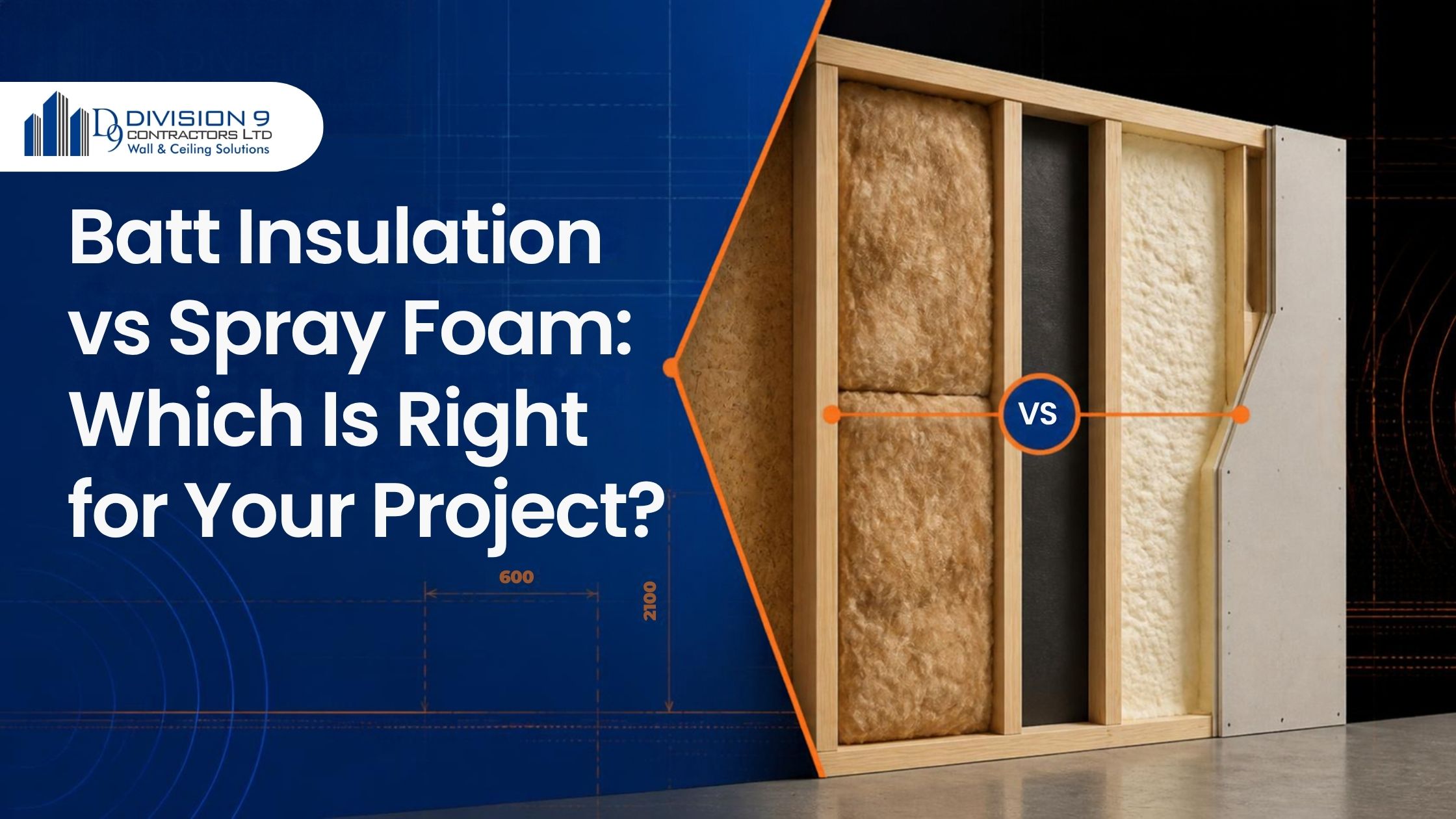
Choosing the right insulation material is a pivotal decision during residential, commercial, or industrial construction in British Columbia. Insulation directly impacts building energy efficiency, occupant thermal comfort, moisture management, indoor air quality, and overall project costs.
Two of the most prevalent insulation choices across British Columbia are traditional batt insulation and spray foam insulation. Understanding their performance characteristics, R-values, application methods, and cost structures ensures your project achieves optimal energy performance and code compliance.
1. Understanding Batt Insulation
Batt insulation consists of pre-cut flexible blankets or rolls made primarily from fiberglass or mineral wool (rockwool). It is sized specifically to fit standard 16-inch or 24-inch stud and joist spacing in wall, floor, and ceiling cavities.
Advantages of Batt Insulation
- Cost-Effective: Batt insulation remains one of the most budget-friendly thermal barrier options per square foot, making it ideal for large-scale developments.
- Excellent Sound Attenuation: High-density mineral wool batts excel at absorbing airborne sound waves, making them a primary choice for interior acoustic partition walls and floor assemblies.
- Fire Resistance: Mineral wool batts are non-combustible and can withstand temperatures exceeding 1,000°C (1,832°F), providing essential fire-blocking performance in code-rated wall assemblies.
- Simple Installation: Batt insulation installs quickly into open stud bays without requiring specialized curing or expansion times.
Considerations for Batt Insulation
- Air Leakage Risks: Batt insulation does not create an air barrier on its own. Air gaps, compression folds, or unsealed perimeter edges allow convective airflow, reducing effective thermal resistance.
- Requires Separate Vapor Barrier: In British Columbia’s climate, batt insulation must be paired with a meticulously sealed 6-mil polyethylene vapor barrier to prevent interior moisture from condensing inside exterior wall cavities.
2. Understanding Spray Foam Insulation
Spray foam insulation is a liquid polyurethane compound sprayed directly into open stud bays, rim joists, and ceiling decks. Upon contact, the liquid expands rapidly, filling cracks, gaps, and voids before hardening into a solid insulating layer. Spray foam is classified into two distinct types: Open-Cell Spray Foam and Closed-Cell Spray Foam.
Advantages of Spray Foam Insulation
- Superior R-Value per Inch: Closed-cell spray foam delivers an impressive thermal resistance of approximately R-6.0 to R-7.0 per inch, far exceeding standard batt insulation (R-3.2 to R-4.2 per inch).
- Integrated Air and Vapor Barrier: Closed-cell foam creates a continuous, monolithic air barrier and moisture retarder that completely seals building envelopes against draft and vapor migration.
- Structural Rigidity: Closed-cell foam hardens into a dense structure that increases wall rack strength and structural integrity in timber and light gauge steel framing.
- Fills Irregular Cavities: Spray foam expands effortlessly around electrical conduits, plumbing pipes, and irregular architectural shapes where batts would require heavy notch cutting.
Considerations for Spray Foam Insulation
- Higher Initial Capital Investment: Spray foam requires specialized equipment and trained application teams, making the upfront material and labor costs higher than traditional batts.
- Requires Professional Safety Protocols: Spraying foam requires proper site ventilation and temporary evacuation during the initial spraying and curing process.
Direct Comparison Matrix
| Performance Metric | Fiberglass / Mineral Wool Batts | Open-Cell Spray Foam | Closed-Cell Spray Foam |
| Thermal Resistance | R-3.2 to R-4.2 / inch | R-3.6 to R-3.8 / inch | R-6.0 to R-7.0 / inch |
| Air Sealing Ability | Requires separate air barrier | Built-in air barrier | Built-in air & vapor barrier |
| Moisture Resistance | Absorbs moisture if unsealed | Permits vapor permeability | Impermeable to liquid & vapor |
| Acoustic Absorption | Exceptional (High Density) | Moderate | Lower (Rigid density) |
| Upfront Installed Cost | Low to Moderate | Moderate | Higher |
Matching Insulation Types to Your BC Building Application
Determining whether batt insulation, spray foam, or a hybrid system is right for your project depends on your specific building envelope goals and climate requirements:
- Exterior Walls & Rim Joists in High-Moisture Coastal BC: Closed-cell spray foam provides superior protection in coastal zones like Vancouver, Richmond, Delta, and North Vancouver by sealing air leaks and blocking driving rain moisture at critical rim joist intersections.
- Basement Foundations & Crawl Spaces: Spray foam or hybrid continuous insulation prevents ground dampness and concrete condensation in lower-level renovations across Surrey, Langley, Abbotsford, and Chilliwack.
- Interior Demising Walls & Tenant Separations: High-density mineral wool batts remain the optimal choice for interior soundproofing in offices, multi-family suites, and healthcare facilities across Burnaby, Coquitlam, and New Westminster.
- Hybrid Assembly Systems: Combining a 2-inch flash layer of closed-cell spray foam against the exterior sheathing with high-density batt insulation filling the remainder of the stud bay delivers high R-values and air sealing at an optimized price point.
Complete Insulation and Wall Assembly Services
Division9 Contractors Ltd offers comprehensive insulation solutions tailored to commercial, industrial, institutional, and residential projects across British Columbia. Our teams specialize in light gauge steel framing, batt insulation, spray foam application, spray insulation, acoustical assemblies, and Level 4 and Level 5 drywall finishing.
We serve clients throughout Surrey, Vancouver, Burnaby, Richmond, Langley, Coquitlam, Abbotsford, Delta, Maple Ridge, New Westminster, North Vancouver, West Vancouver, Squamish, Whistler, and Chilliwack.