
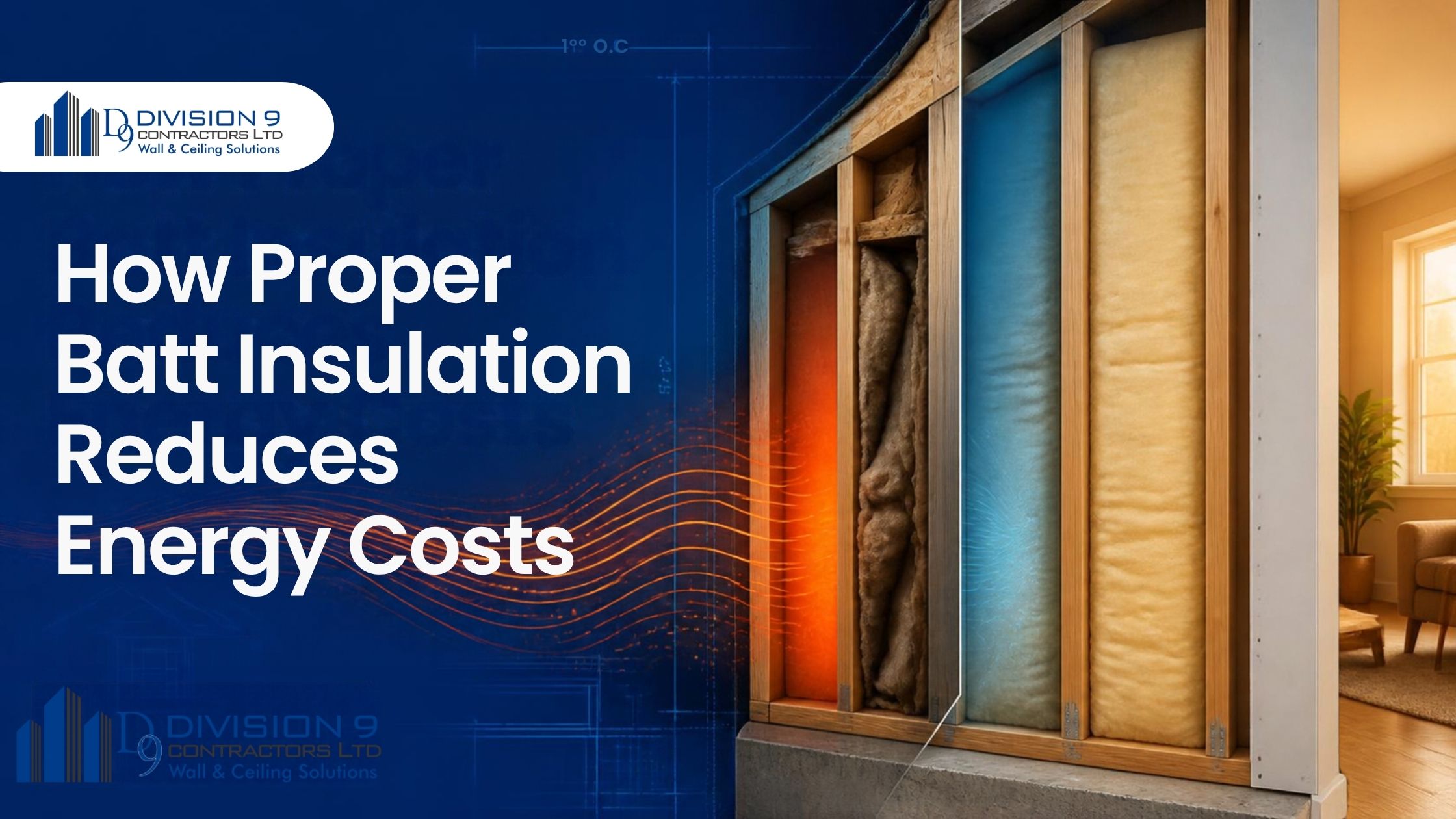
Heating and cooling account for more than half of a standard building’s energy consumption in British Columbia. As regional utility rates evolve and energy efficiency standards under the BC Building Code and BC Energy Step Code tighten, minimizing heat loss through building envelopes is critical.
Properly installed batt insulation provides a cost-effective, high-return thermal defense layer. According to BC Hydro, upgrading building insulation typically yields at least a 10% reduction in overall heating and cooling costs while significantly improving indoor thermal comfort.
1. Thermal Resistance and Stopping Heat Transfer
Batt insulation—manufactured from fiberglass or mineral wool (rockwool)—works by trapping millions of microscopic air pockets within its fibrous matrix. Heat naturally flows from warmer areas to colder spaces. In winter, interior heat escapes outward through stud bays and joists; in summer, outdoor heat radiates inside.
- High R-Value Performance:The measure of an insulation material’s ability to resist thermal heat flow is its R-value.The higher the R-value, the greater the insulating effectiveness.
- Meeting BC Code Targets:Standard exterior wall assemblies require minimum thermal performance levels (such as R-20 to R-24) under regional building rules. Fitting dense mineral wool or high-density fiberglass batts snugly into framing cavities stops continuous conductive heat migration.
2. Eliminating Convective Air Movement Within Cavities
Uninsulated or poorly insulated wall cavities act as open chimneys. Temperature differentials between interior and exterior wall sheathing create internal air currents (convective loops) that pull heat away from living spaces.
Installing full-friction fit batt insulation completely fills the void between steel studs or wood framing. This halts internal air circulation within the cavity, stabilizing temperature gradients across drywalled surfaces and keeping interior spaces warmer in winter and cooler in summer.
3. Reducing Heating and Cooling System Strain
When a building envelope leaks heat, mechanical HVAC systems must work harder and cycle continuously to maintain set thermostat temperatures.
- Lower Monthly Utility Bills: Reducing thermal loss decreases the overall heating load (whether gas, electric baseboard, or heat pump), directly cutting monthly electricity and gas consumption.
- Extended HVAC Lifespan: Equipment that operates on shorter, balanced cycles experiences less mechanical wear and tear, reducing ongoing repair costs and extending equipment operational life.
4. Proper Installation Precision: Avoiding Costly Thermal Bypass
Batt insulation delivers maximum energy savings only when installed with strict attention to detail. Defective installation can reduce an assembly’s nominal R-value by up to 30% to 50%.
To guarantee full thermal performance:
- Zero Compression Folds: Squeezing thick batts into shallow cavities breaks the air pockets needed for thermal resistance, drastically lowering overall performance.
- Tight Friction Fit: Batts must be cut accurately (typically 1/2 inch wider than stud bay width) to ensure snug, gap-free perimeter contact along framing studs and plates.
- Utility Detailing: Cutting precise notches around electrical junction boxes, piping, and conduit prevents voids behind wires where heat freely escapes.
5. Capturing BC Utility and Energy Rebates
To offset initial construction or renovation costs, homeowners and building managers across British Columbia can take advantage of substantial energy efficiency rebate programs.
- BC Hydro and FortisBC Rebates:Regional utility programs offer rebates calculated per square foot of qualified insulation added (e.g., up to $1,200+ for wall and basement upgrades).
- CleanBC Energy Savings Program:Income-qualified households and commercial efficiency retrofits can access enhanced rebates covering up to 60% to 95% of upgrade expenses.
Regional Building Envelope Considerations Across BC
| Region | Primary Thermal Challenge | Insulation Focus Area |
| Lower Mainland (Vancouver, Surrey, Burnaby, Delta) | Damp winter cold & coastal humidity | Mineral wool batts paired with sealed air/vapor retarders |
| Fraser Valley (Abbotsford, Chilliwack) | High winter wind washing & temperature swings | Full-cavity friction-fit batts with rim joist sealing |
| Sea-to-Sky Corridor (Squamish, Whistler) | Severe freezing conditions & high heating demand | High R-value cavity batts combined with continuous insulation |
Professional Insulation and Drywall Services
Division9 Contractors Ltd supplies and installs high-density mineral wool and fiberglass batt insulation, spray insulation, spray foam, light gauge steel stud framing, and Level 4 and Level 5 drywall finishing. We ensure wall and ceiling assemblies achieve code compliance, maximum energy efficiency, and long-term utility savings.
We serve commercial, industrial, institutional, and residential developments across Surrey, Vancouver, Burnaby, Richmond, Langley, Coquitlam, Abbotsford, Delta, Maple Ridge, New Westminster, North Vancouver, West Vancouver, Squamish, Whistler, and Chilliwack.